




- Global Collaboration Center
- Activity
- Report on 33rd SDGs Seminar "See, Hear, and Take Action! JICA Overseas Cooperation Volunteers in the Kingdom of Tonga”
ページの本文です。
Report on 33rd SDGs Seminar "See, Hear, and Take Action! JICA Overseas Cooperation Volunteers in the Kingdom of Tonga”
2024年8月2日更新
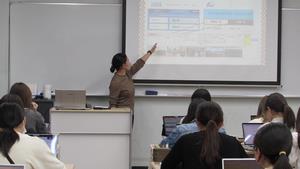
Ms. Ito explaining the JICA Overseas
Cooperation Volunteers Program
On November 8, the Global Cooperation Center hosted the 33rd Sustainable Development Goals (SDGs) seminar. For this seminar, we invited Ms. Ito, a former JICA Overseas Cooperation Volunteer (JOCV) in the Kingdom of Tonga, who engaged in community development there. She is currently pursuing a Master's degree at Ochanomizu University. Ms. Ito spoke about her experiences in the field and in the JOCV program.
First, Ms. Ito discussed the training and preparation for the program. Before deployment, participants undergo job-specific training and several months of pre-deployment training covering language and living skills. Upon arrival in the host country, participants receive an additional month of local language training. During pre-deployment training, participants from various professions across Japan gather, creating an environment where they live with people they would not normally encounter in daily life.
Next, we heard about her activities in Tonga. Ms. Ito's assignment with the JOCV was to increase knowledge and awareness of lifestyle-related diseases among islanders and encourage healthier dietary habits.
In Tonga, 70% of the population is said to suffer from or be at risk for lifestyle-related diseases. She was assigned to the Eua Branch of the Ministry of Agriculture and Forestry, which is located on Eua Island. This remote island has 15 villages and a population of about 5,000.
Information channels like the internet are not widespread on remote islands, and the variety of vegetables available at the market is limited. In a class discussion, each person considered what approach they would take in Ms. Ito's situation. As outsiders with no experience with island daily life or culture, we recognized the difficulty of engaging with a nation's policies while respecting the island way of living and the challenges of the "grassroots diplomat" position. We concluded that building bonds with local people and becoming a trusted presence requires immersing oneself in local life as a member of the island community and constantly learning from those around you more than simply implementing policies.
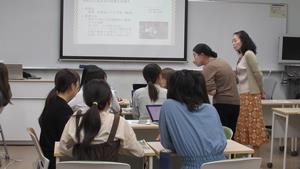
Discussion on the approach of the JOCV to their
work in developing countries
In practice, Ms. Ito worked with her counterpart to tour all 15 villages and conduct awareness and situation surveys. She cultivated and distributed vegetable seedlings, established a women's community committee, and organized a training session for JICA volunteers assigned to the Pacific region.
Despite facing various challenges during her service, she was supported by the warmhearted people there. While raising awareness among islanders in the short span of about two years is difficult, I found Ms. Ito admirable. She continued her activities, aiming to "be a catalyst for someone," driven by a desire to contribute to those around him in some way. I believe this embodies the JOCV' slogan, "The power to change the world someday."
In the last part of the seminar, we learned about Ms. Ito's current activities. She is researching international migration in Tonga and its sustainability in graduate school.
She is also advancing her studies as a Japanese language teacher, honing skills she can leverage overseas as a Japanese national. Her experience with the JOCV has clearly provided her with numerous opportunities.
Through the seminar, I gained a deeper understanding of the JOCVs' activities. Through Ms. Ito's story, I was drawn to the unique life experiences gained through living in a culture different from Japan's and to the JOCV program that provides such opportunities. Furthermore, as a fellow Ochanomizu University student, Ms. Ito's story served as a reference for my own career development. I will keep in mind how to engage with the world as a working professional, seize various opportunities, and value the connections I make in every setting. I intend to always "see, listen, and act," and treasure my remaining time at university. Thank you very much for your valuable talk this time.
(Junior student, Department of Liberal Arts and Humanities, Faculty of Letters and Education)



〒112-8610 東京都文京区大塚2-1-1
責任者:お茶の水女子大学グローバル協力センターHP運営委員会
E-mail:info-cwed@cc.ocha.ac.jp

Copyright © OCHANOMIZU UNIVERSITY. All rights reserved.