



- Global Collaboration Center
- Activity
- Participating in the Japan-Korea Youth Friendship Exchange Program for Fiscal Year 2023
ページの本文です。
Participating in the Japan-Korea Youth Friendship Exchange Program for Fiscal Year 2023
2025年1月6日更新
As a Japanese youth representative for the 34th Japan-Korea Youth Friendship Exchange Program, jointly hosted by Japan's Cabinet Office and South Korea's Ministry of Gender Equality and Family, I participated in activities from July 2023 to February 2024, spanning eight months. Centered around a 15-day dispatch program to South Korea scheduled for October, the project consists of pre-dispatch training, independent study, the dispatch program itself, post-dispatch training, and a debriefing session. A total of 30 participants—25 Japanese youth representatives and 5 leaders—took part. Now that the project has concluded, each member is focusing on “post-project activities,” pursuing their own paths based on the insights gained during the dispatch program and setting new goals.
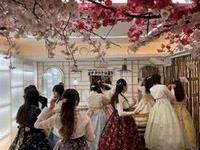
Photo 1: Hanbok Experience
I chose the red chima (skirt).
During the main program of this initiative—the dispatch period in South Korea—participants will visit eight cities (Seoul, Yeoncheon, Wonju, Pungpa, Andong, Pohang, Gyeongju, and Seongnam). Pohang, Gyeongju, and Seongnam). We engaged in exchange activities with Korean youth, experienced Korean culture, visited art museums and historical museums, and paid courtesy visits to the local Japanese Embassy and government agencies. Actually visiting these places made me realize that the Korean culture I had received in Japan was centered on subculture elements. Even though it symbolizes Korean culture, it was only superficial information. For instance, my first exposure to hanbok (Korean traditional clothing) was through K-pop idol content. I had perceived hanbok itself as predominantly pale colors with white as the base, giving it a monotonous image rather than an opulent one. Consequently, I assumed hanbok was only worn for important occasions like Lunar New Year or weddings. However, visiting Korea revealed that hanbok is widely accessible and deeply integrated into everyday life, worn casually by everyone from young people to foreigners. I also discovered the diverse designs and colors of hanbok, and its customizable nature, allowing people to tailor it to their preferred style. Comparing it to Japan's kimono culture, I experienced how Korean traditional and modern cultures blend naturally. (Photo 1)
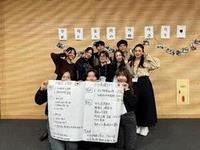
Photo 2: Discussion with Korean Youth
We discussed the declining birth rates in Japan and South Korea.
During the dispatch period, we not only interacted with the Korean youth delegation but also had numerous opportunities to engage with young people while touring various cities. Deepening our conversations about mutual interest in each other's countries and daily lives, and even discussing social issues common to both Japan and Korea, fostered a growing awareness of our roles as young people who will shape society in the future. (Photo 2) Furthermore, I still keep in touch with the Korean youth that I met through the program. Whenever we visit each other's countries, we always reunite. I believe that building friendships that extend beyond the program itself is the first step in becoming a bridge for Japan-Korea exchange.
Lastly, the experience of participating in this program as a representative of Japanese youth became a crucial opportunity that extended beyond my interest in Korea, allowing me to clearly envision becoming a woman who can thrive globally. Moving forward, I will strive to promote the significance of this exchange program through follow-up activities and play a part in revitalizing Japan-Korea exchanges.
(S.A, junior student, Department of Liberal Arts and Humanities, Faculty of Letters and Education)



〒112-8610 東京都文京区大塚2-1-1
責任者:お茶の水女子大学グローバル協力センターHP運営委員会
E-mail:info-cwed@cc.ocha.ac.jp

Copyright © OCHANOMIZU UNIVERSITY. All rights reserved.