




- Global Collaboration Center
- Activity
- Report on 39th SDGs Seminar "Improving Sanitation and Hygiene for 100 Million People through Toilets- SATO's Commitment to the Global Sanitation Challenge"
ページの本文です。
Report on 39th SDGs Seminar "Improving Sanitation and Hygiene for 100 Million People through Toilets- SATO's Commitment to the Global Sanitation Challenge"
2025年4月1日更新
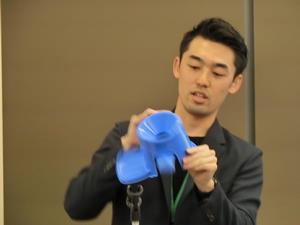
Mr. Shimojo explaining the "SATO TAP” handwashing
station utilizing recycled plastic bottles
On Wednesday, May 8, the 39th Sustainable Development Goals (SDGs) Seminar took place from 4:40 to 6:10 p.m. in the Multipurpose Hall on the second floor of the International Exchange Plaza for International Students at Ochanomizu University. Mr. Akihito Shimojo from the SATO Division of LIXIL Corporation was our guest speaker. LIXIL Corporation is a leading Japanese manufacturer of housing equipment. Mr. Shimojo presented on the theme: "Improving Sanitation and Hygiene for 100 Million People through Toilets- SATO's Commitment to the Global Sanitation Challenge”. Through his lecture, we reconsidered the importance of sanitation, drawing on Mr Shimojo's personal experiences and LIXIL's initiatives.
LIXIL is a major housing equipment manufacturer that operates diverse brands both domestically and internationally, primarily offering products such as kitchens, baths, faucets, and windows. Its raison d'être is “realizing the rich and comfortable homes that everyone around the world desires”. LIXIL is also actively engaged in initiatives related to the SDGs. One notable business effort in this area is the “SATO” project. 'SATO' is a simple toilet system developed for developing countries. Designed to be affordable while incorporating water-saving and hygiene considerations, it features a compact design and easy installation. It was developed specifically for use in areas such as rural Asia and Africa, where safe and hygienic toilets are lacking. The SATO initiative began in Bangladesh. By adapting its products to local cultures and lifestyles, it has shipped approximately 7.5 million units to 45 countries worldwide, improving sanitation for 45 million people.
Currently, it is estimated that 3.5 billion people worldwide lack access to safely managed and maintained toilets. 410 million people defecate outdoors. 2 billion people lack handwashing facilities at home. 1,000 children under five die every day from diseases caused by unsanitary water and poor sanitation. Even when toilets exist in living environments, they are often poorly managed, leading to foul odors and insects that spread pathogens. Many people still go to the toilet in roadside grassy areas because the toilets are not usable. When school toilets are in such a state, for example, inadequate sanitation causes various problems: children become ill because they cannot use the toilet when needed, and women face sexual assault due to a lack of toilet privacy.
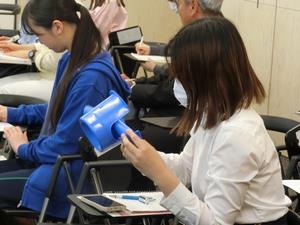
Participants picking up the “SATO Tap” to examine its features
During his visit to the Philippines, Mr Shimojo witnessed a young girl defecating outdoors right before his eyes. The Philippines is a populous country with an average age of just 24. Mr Shimojo stated that this experience reminded him of the importance of the SATO initiative and of improving sanitation worldwide. He recognised that improving sanitation in such a populous country with a high proportion of children would increase lifespans and enable further national development.
However, Mr Shimojo also taught us about the challenges of selling SATO products locally. Open defecation is a daily norm for the local people, who lack the habit of using toilets. Consequently, he said it is difficult to convey the appeal of SATO products. For us Japanese people, the word 'toilet' conjures images of large, built-in flush facilities, so we can easily understand the appeal of SATO's affordable, simple-to-install products. However, the concept of a toilet differs significantly for local people, and their understanding of the importance of sanitation is limited. Consequently, they find it difficult to perceive SATO's features as appealing. Therefore, to promote SATO products in developing countries, he says we must first educate people about proper sanitation practices. Recently, however, they have been focusing on educational activities for residents in cooperation with international and government agencies, and understanding is gradually improving.
Mr Shimojo concluded by saying that, although conveying SATO's appeal across cultural differences is extremely challenging, the sense of accomplishment when that appeal is understood and an installation is achieved is unparalleled. I have experienced homestays in rural Philippine towns myself and recall being shocked by the poor state of their toilets and other water facilities. However, I was even more surprised that they didn't question this situation at all. I had been wondering how to bridge the gap between our values regarding sanitation and hygiene. Attending this lecture made me recognize the importance of a steady educational approach. While changing values is undoubtedly a long and difficult process, I was excited to learn that there are Japanese people striving to improve people's lives by engaging various stakeholders. This made me want to get involved in ambitious projects like SATO in the future. I would like to thank Mr Shimojo for sharing his valuable insights despite his busy schedule.
(Kitazawa, junior student, Department of Languages and Culture, Faculty of Faculty of Letters and Education)
【related links】
LIXIL Cooperation and SATO related links  Global Sanitation & Hygiene



〒112-8610 東京都文京区大塚2-1-1
責任者:お茶の水女子大学グローバル協力センターHP運営委員会
E-mail:info-cwed@cc.ocha.ac.jp

Copyright © OCHANOMIZU UNIVERSITY. All rights reserved.