




- Global Collaboration Center
- Activity
- Report on "JICA Tsukuba-Hosted 'International Cooperation Understanding Program for Undergraduate and Graduate Students'"
ページの本文です。
Report on "JICA Tsukuba-Hosted 'International Cooperation Understanding Program for Undergraduate and Graduate Students'"
2025年1月6日更新
From Monday, August 19th to Friday, August 23rd, I participated in the “International Cooperation Understanding Program for Undergraduate and Graduate Students” hosted by JICA Tsukuba. The program offered an agriculture course for students studying agricultural technology and a practical international cooperation course for students interested in international cooperation, particularly aid in developing countries. I participated in the latter program. The first two days were conducted online, with approximately 40 students participating.
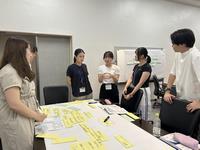
Group work in progress
On the first day, we gained an understanding of the importance of international cooperation and Japan's ODA. We also had the opportunity to hear from staff at the Myanmar office online about their work. I learned that the process leading up to project implementation involves many steps, from coordinating role-sharing with other agencies to conducting field surveys. I also learned that the role emphasizes being a generalist who oversees the entire process. Seeing the staff work to identify local needs and explore solutions, even amidst unstable domestic conditions, impressed me.
On the second day, we heard case studies from representatives of an NGO implementing livelihood improvement projects in South America and Africa, and from a development consultant involved in the “Everyone's School” project in Africa. We gained a real sense of the diverse actors present in the field of international cooperation. We also learned that to achieve grassroots international cooperation, it is vital to persistently continue approaches at a small scale—such as focusing on a single household or a single school.
From the third day onward, the training shifted to group work at JICA Tsukuba. Meeting the students I'd only seen online in person was truly a joyful moment. Beyond that, interacting with fellow students equally passionate about international cooperation not only boosted my motivation to study but also inspired me with their sharp insights from different perspectives.
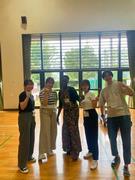
A Photo with Trainees from Uganda
During the group work, we experienced PCM (Project Cycle Management) training, a methodology actually used in the field. It was very challenging and interesting. Over a day and a half, we considered solutions for issues in developing countries. First, we had to identify the core problem and its causes without jumping to conclusions, then create a problem tree and select an approach. While opinions sometimes clashed within the group, the time spent discussing and thinking together was enjoyable. From the instructor, we learned important perspectives such as “seeing with a bird's eye view” (objectively grasping the situation) and “what isn't there doesn't exist” (utilizing local resources).
Additionally, the program offered numerous valuable opportunities, such as a lunch meeting with trainees from Uganda and a career consultation session with JICA staff members.
Through this program, meeting fellow students with shared aspirations and encountering many role models working in international cooperation helped me gain clarity on how I want to engage with international cooperation moving forward. I aim to apply the lessons learned from this program and strive to reunite as an active participant.
(S.Y, junior student, Department of Languages and Culture, Faculty of Letters and Education)



〒112-8610 東京都文京区大塚2-1-1
責任者:お茶の水女子大学グローバル協力センターHP運営委員会
E-mail:info-cwed@cc.ocha.ac.jp

Copyright © OCHANOMIZU UNIVERSITY. All rights reserved.