



- Global Collaboration Center
- Activity
- Report on the 49th SDGs Seminar “Peace and Dignity in an Age of Violence” (May 19, 2025)
ページの本文です。
Report on the 49th SDGs Seminar “Peace and Dignity in an Age of Violence” (May 19, 2025)
2025年6月19日更新
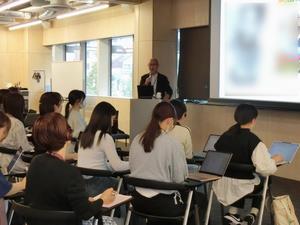
Scene from the seminar 1
On Monday, 19 May 2025, the 49th SDGs Seminar, titled "Peace and Dignity in an Age of Violence", was held. The guest speaker was Mr. Yoichi Mine, Director of the JICA Ogata Sadako Research Institute for Peace and Development. The seminar provided an opportunity to explore the concept of dignity and the right of every individual to live with dignity.
The lecture began with a history of violence. After introducing the book A History of Violence, Mr. Mine explained that the 'desire for peace' and the 'destructive impulse' coexist within the human heart and society. Building on this, we learned about the history of violent subjugation in South Africa — Mr. Mine's area of expertise — and the plight of South Africans who were treated as mere tools and killed for justifiable reasons. One particularly striking phrase was “Human beings are ends in themselves, not means”. Coined by the German philosopher Kant, this phrase means that humans should respect other humans as irreplaceable beings. According to this moral principle, everyone is equal. I felt that this absolute dignity must not be violated, not even by the state.
I also learned the beautiful South African word 'ubuntu'. Translated into English, it means 'I am because you are'. As people are sustained by others, it is only through our relationships with them that we are recognized as human beings. This is a concept that must be remembered throughout life. It also encompasses the vital idea of mutual respect. Although acknowledging each other's dignity may seem abstract, I believe that being aware in our daily lives that we are sustained by those around us fosters respect for others' existence.
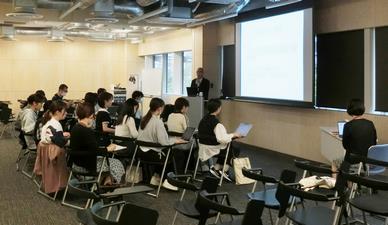
Scene from the seminar 2
Sadly, however, I feel that recognition of a single, large community called 'human society' is fading in the modern world. A person is a member of human society before they are a member of any nation. Clearly, individuals — each with equal dignity — must work together to build a better society. Amid accelerating environmental destruction triggered by humans, along with the resulting disasters and climate change, many people are being driven from their homes, unable to harvest crops, and are being deprived of decent lives. Humankind must take responsibility for solving these problems together. I believe that the killing and violation of each other's dignity stems from a lack of awareness that we are all part of the same human community. This year marks 80 years since the term 'human dignity' began appearing in legal texts following World War II. Even today, despite widespread advocacy for human security, people continue to die senseless deaths from conflict, hunger and violence. Mr Mine's graph of global life expectancy (1950–present) showed years when figures dropped significantly in specific regions. In East Asia, for instance, this was due to the Great Leap Forward, whereas in Southeast Asia it coincided with the rise and fall of the Suharto regime. In Europe, the decline followed the collapse of the Soviet Union, while in Africa, it resulted from the HIV/AIDS epidemic that claimed many young lives. I was horrified to realize that a nation's right to life could be so profoundly affected by a single government policy or state system. Hearing Mr Mine speak about how to smooth out the peaks and troughs in this graph made me feel the loss of the lives behind them, and made me realize how necessary it is to eliminate these senseless deaths.
I believe it is crucial that we now sincerely confront the core challenge of the SDGs — 'leaving no one behind' — by returning to the essence of the word 'dignity': something noble in status, solemn in conduct, and inviolable in essence.
(R.S., freshman student, Department of Human and Social Sciences, Faculty of Letters and Education)



〒112-8610 東京都文京区大塚2-1-1
責任者:お茶の水女子大学グローバル協力センターHP運営委員会
E-mail:info-cwed@cc.ocha.ac.jp

Copyright © OCHANOMIZU UNIVERSITY. All rights reserved.