




- Global Collaboration Center
- Activity
- Report on Cambodia Study Tour (2025)
ページの本文です。
Report on Cambodia Study Tour (2025)
2025年12月1日更新
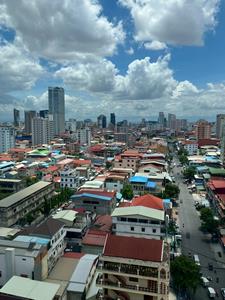
The city of Phnom Penh
From August 21 to 29, 2025, a study tour to Cambodia was conducted as part of the course “Practicum for a Convivial Global Society FY 2025”. Five students set different research themes, such as civic education, views on marriage, perceptions of international aid, regional disparities in access to higher education, and gender equality, and conducted interviews and on-site surveys.
Upon landing at Phnom Penh International Airport and driving through the city, we were surprised to find Phnom Penh far more urban than we had imagined. Right next to ancient, glittering temples stood large buildings funded by foreign capital. The roads were filled with cars and tuk-tuks, with motorcycles weaving through them. This blend of tradition and urban vibrancy felt incredibly fresh, and the bustling crowds made it clear we were in a country truly developing right now.
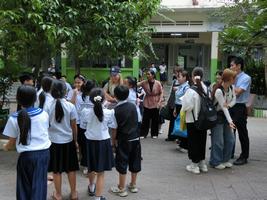
At Preah Norodom Primary School
First, we visited a kindergarten run by Japanese staff. In Cambodia, many kindergartens operate by renting elementary school buildings, and kindergartens with playgrounds or a strong focus on play, like those in Japan, are apparently rare. It seems common in Cambodia for children to be fed powdered milk until around age four due to insufficient knowledge about proper childcare. Hearing how the kindergarten staff wanted to convey correct knowledge to parents through their operations, we could feel how deeply they care for Cambodian children. Next, we visited Preah Norodom Public Elementary School. Energetic children surrounded us, chatting away, and despite our foreign appearance, they greeted us warmly with great curiosity. While Cambodian schools use a lecture-style teaching method where children diligently take notes on the teacher's explanations, the children told us with beaming smiles that they find school and their lessons enjoyable.
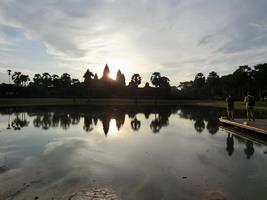
Angkor Wat bathed in morning sunlight
We also visited the Tuol Sleng Genocide Museum and Angkor Wat. At the Tuol Sleng Genocide Museum, our guide, Mr. Buti, shared his personal experiences from the Pol Pot era. His story conveyed the sheer weight of Cambodian life—a life lived through unimaginable hardships and struggles, yet one where he now values family and connections, acknowledging and forgiving those he once resented, living in the present. We visited Angkor Wat early in the morning, as our guide recommended. Bathed in the morning sun, Angkor Wat was truly beautiful. The air was crisp, and I felt a sense of sacredness. Stepping inside, I sensed the deep-rooted politeness and reverence for parents that form the foundation of the Cambodian spirit. I also witnessed firsthand the transition from Hinduism to Buddhism and the traces of religious persecution endured during the Pol Pot era. I also watched the Apsara dance, a traditional Cambodian dance. Though not flashy, its elegant and intricate movements captivated me. It was fascinating to see how they weave culture by reviving and creating traditional dances to prevent them from fading, then presenting them as dinner shows for tourists.
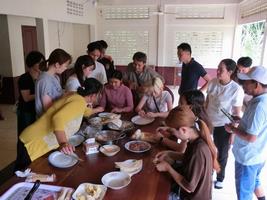
Lunch preparation with members of the NPO Terra Renaissance
Next, we visited Battambang, Cambodia's second-largest provincial city. In Battambang, we visited an agricultural training school run by the certified NPO Terra Renaissance. We interviewed young people of our generation learning agriculture there, cooked together, and shared a meal. They enjoyed TikTok, laughed at silly jokes, and teased me about my cooking skills—I felt Cambodian youth share many similarities with us. Yet, seeing them—those who dropped out of high school or couldn't afford university—choose agriculture, struggle to stay motivated, and learn daily to carve out their own livelihoods, made me realize anew how fortunate we are in Japan to have such a wide range of future options. Many staff members at the agricultural training school had arrived at their current jobs after various career paths. It was wonderful to see them living their lives with pride and fulfillment in their work, truly enjoying it. Among them, one person particularly impressed me. She shared that while she teaches trainees at work, she also learns a great deal from them. She finds happiness in talking about these things with her family. She explained that work isn't always fun; there are tough times too. But overcoming those challenges is part of what makes the job enjoyable. Furthermore, regarding education, she expressed concern about the one-way, teacher-centered lectures common in Cambodian schools. She believes schools should implement initiatives fostering critical thinking. I was drawn to her positive, powerful mindset and her unwavering commitment to maintaining her own critical thinking skills.
Furthermore, I had the opportunity to speak with staff at a kindergarten pioneering innovative initiatives for children and the community, and also heard directly from mothers during home visits. Additionally, a local staff member of the same age working for Shanti International Volunteer Association guided me around the city, and the JICA Cambodia office kindly answered numerous questions. Moreover, sharing meals with our guide, Mr. Vutey, and our driver, Mr. Red, allowed me to hear multifaceted perspectives on Cambodia and learn through firsthand experience.
I conducted research on sovereignty education in Cambodia. Under the current one-party rule, freedom of political expression is severely restricted, and the political system and rights are not adequately addressed in educational settings. Consequently, it is difficult to argue that democracy is functioning fully. However, Cambodians have a strong sense of ownership toward their affiliated groups and regions. They act proactively based on the belief that "by taking action, I can improve the group." Through interviews, it became clear that this sense of agency was often forged out of necessity during the desperate struggle to survive under the Khmer Rouge regime. Nevertheless, the attitude of striving to improve daily life and society has been passed down to the present day. The youth radiate vitality and a powerful drive to forge their future. It was also evident that, through education and employment, society as a whole is striving to support these efforts. Even in an environment lacking resources and opportunities, their attitude of creating and seizing chances for themselves, coupled with a way of life that values others, left me with a strong desire to learn from them.
Lastly, two things left a strong impression on me during my visit to Cambodia. First, I noticed the stark disparity between the rich and poor within the country. Right next to grand houses were makeshift ones, and beside families sending their children to lessons were families where children were helping with work or household chores. In urban areas, large buildings stand side by side, presenting a landscape not vastly different from that of Japan. However, the scene changes completely in rural areas, where shops become open-air stalls without walls and children selling goods can be seen. While dining on a restaurant terrace, a child approached me, asking if I wanted to buy vegetables. I felt utterly powerless. Buying from them might have provided the children with income, but it could also have contributed to adult exploitation. I realized that I lacked the means to support the child's livelihood. Equally striking was seeing a seemingly Western man waving off the child with "I can't give you money" while handing over a book instead of vegetables. I sensed a strong message: Even with tight household budgets, child labor is unacceptable, and children should be educated. The second point was the concern of restrictions on freedom. Photos of the prime minister, the former prime minister, and the prime minister's mother were displayed everywhere, in restaurants and around town. I often received little response to political questions, and young people would quietly tell me, "We can't talk about politics." There was definitely an atmosphere in which voicing opposition to the government was impossible. Furthermore, following the conflict near the Thai border a few months prior, I was shocked to see signs honoring soldiers throughout the city and to hear comments such as "no one is opposing it" or "some people might dislike it, but..." regarding plans to fully implement conscription starting next year. This made me anxious that the conflict might escalate further.
Despite this, Cambodia was a country with delicious food, vibrant streets, and incredibly warm people. I encountered many ways of life and perspectives worthy of respect. Visiting in person and listening to people's stories made me realize how much my preconceived image had changed. Having now visited Cambodia, my vague interest has transformed into a sincere wish for each person I met on this study tour to realize their hopes and goals. I want to continue valuing seeing with my own eyes, listening with my own ears, feeling with my own skin, and maintaining multifaceted thinking when hearing the voices of people with diverse perspectives.
I would like to extend my heartfelt gratitude to everyone who supported this study tour.
(Hinano Matsuo, senior student, Department of Letters and Education)
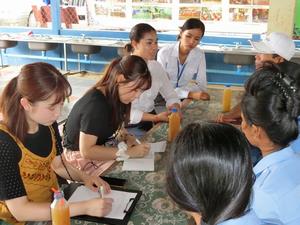 Interviews with Teachers at Prek Norlen Kindergarten
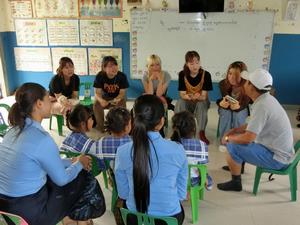 Interviewing children at Prek Norlen Kindergarten



〒112-8610 東京都文京区大塚2-1-1
責任者:お茶の水女子大学グローバル協力センターHP運営委員会
E-mail:info-cwed@cc.ocha.ac.jp

Copyright © OCHANOMIZU UNIVERSITY. All rights reserved.