




- Global Collaboration Center
- Activity
- Report on Komagane City Study Tour Report (Five Women's University Consortium)
ページの本文です。
Report on Komagane City Study Tour Report (Five Women's University Consortium)
2025年12月2日更新
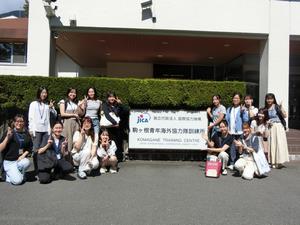
At JICA Komagane Training Center
From September 1 to 3, 2025, we conducted a joint domestic study tour in Komagane City, Nagano Prefecture, for the Five Women's Universities Consortium, continuing from the 2024 academic year.
During the tour, participants visited the JICA Komagane Training Center in Komagane City, Nagano Prefecture, where they learnt about JICA's international cooperation activities and the Komagane City initiatives promoting multicultural coexistence. The tour aimed to deepen understanding of international cooperation conducted by individuals and local governments,and to facilitate networking through exchanges with like-minded students from other universities. Fifteen students took part: three each from Ochanomizu University, Tsuda University, Tokyo Woman's Christian University, Nara Women's University and Japan Women's University.
(The following is a report by participating students.)
During this study tour, we visited Komagane City. There, we gained first-hand insights into 'coexistence' from different perspectives: the coexistence between Komagane citizens and foreign residents living in Komagane; citizen-level international exchange between Komagane City and its sister city, Pokhara City in Nepal; and international cooperation involving the dispatch of personnel to developing countries by JICA (Japan's independent administrative agency).
Earthling Network in Komagane started by teaching Japanese to foreign residents in Komagane City. During our visit, we could tangibly feel the 'coexistence' between people originally from overseas and those who have always lived in Komagane. On the day of our visit, they had even prepared sweets from their home regions. It was clear that this wasn't just a one-way relationship of teaching Japanese; rather, it was a connection as fellow residents of Komagane and friends. While xenophobia towards foreigners has been on the rise in Japan in recent years, communities like this one offer hope by showing that foreign residents and Japanese people can live together.
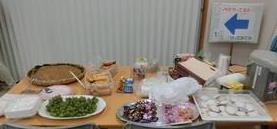
We were treated to homemade sweets from
the members ofEarthling Network in Komagane.
It was also striking that several former JICA volunteers were among the staff of both the Earthling Network in Komagane and the Citizen's Association for Nepal Exchange, due to the presence of a JICA Training Center in Komagane City. Before joining this study tour, I had thought that Overseas Cooperation Volunteers were very special individuals. However, through conversation, I learned that people become Overseas Cooperation Volunteers for a variety of reasons, and that it is open to anyone with the courage to take that first step. Despite facing various difficulties, they cherished their aspirations and carried out their activities. This made the Overseas Cooperation Volunteers feel a bit more relatable.
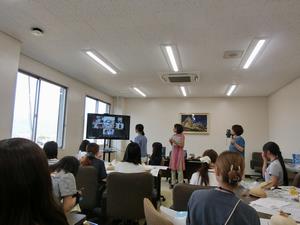
Online exchange with a local midwife from
the Citizen's Association for Nepal Exchange
During this study tour, I questioned whether it might be possible to engage in international cooperation while staying in Japan, even if going overseas is difficult, despite volunteer work conducted in the field being mainstream for international cooperation. Therefore, I participated in this study tour wanting to learn about the Komagane field, where exchange and cooperation are being carried out at a grassroots level. From that perspective, the breast care project was what stood out in the Citizen's Association for Nepal Exchange’s activities. The people working in Komagane mentioned feeling 'connected to the world while staying in their local community', which made a strong impression on me. Furthermore, among the members who participated in the study tour with me, there were individuals who volunteered to teach Japanese to children with links to other countries in their own local communities. This made me realise that engaging in international exchange, starting from one's immediate surroundings, is entirely possible. It also reinforced the importance of actively seeking opportunities and taking the first step towards action. I realised that international cooperation isn't limited to going abroad — there are many things one can do in Japan. This lowered the perceived barrier to international cooperation.
One key insight that I want to carry forward is the importance of taking action to bring about change because merely thinking about it will not achieve anything. Both the Earthling Network in Komagane and the Citizen's Association for Nepal Exchange demonstrate that small individual actions, when accumulated, can have a significant impact. This is particularly evident in the Citizen's Association for Nepal Exchang, whose activities supporting Nepalese mothers and children through breast care and the creation of maternal and child health handbooks have evolved into national and state-level initiatives in Nepal. Although international cooperation is often dominated by activities on a national scale, I witnessed firsthand the importance of sustained engagement, even at the relatively smaller scale of local government. At Ochanomizu University, we are planning presentations at our campus festival, as well as exhibitions and sales of Nepalese handicrafts. I believe that we should continue our involvement in some form.
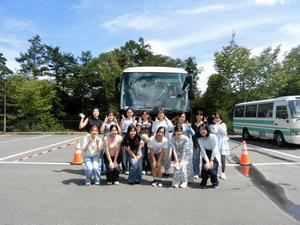
Study tour participants
On the other hand, we also heard candid discussions within the Citizens' Association for Nepal Exchange about challenges such as a shortage of successors and the pros and cons of becoming an NPO. This provided an opportunity to understand the difficulties involved in sustaining such activities.
At the same time, I realized that when engaging in international cooperation, it's important not only to work from Japan but also to see the field firsthand. Human connections seem to become stronger through direct interaction. In particular, I spoke with someone from Nepal via Zoom, and I was impressed by how kindly and openly they shared various stories. I learned that Komagane City and Pokhara City are also preparing opportunities for people-to-people exchanges. I thought that by creating chances to actually feel the presence of the other side, we could come to feel them more personally. I haven't had many opportunities to go overseas myself, but this experience made me want to seek out opportunities and participate.
Through this study tour, I learned that taking action rather than just thinking is crucial in international exchange and cooperation, as is feeling the other party's presence as something close rather than distant. Hearing from the people at the places we visited and learning about the experiences of the other members participating in the same study tour made it a very meaningful time.
(M.I., sophomore student, Faculty of Letters and Education, Ochanomizu University)



〒112-8610 東京都文京区大塚2-1-1
責任者:お茶の水女子大学グローバル協力センターHP運営委員会
E-mail:info-cwed@cc.ocha.ac.jp

Copyright © OCHANOMIZU UNIVERSITY. All rights reserved.