




- Global Collaboration Center
- Activity
- Report on Bhutan Study Tour (2025)
ページの本文です。
Report on Bhutan Study Tour (2025)
2025年12月1日更新
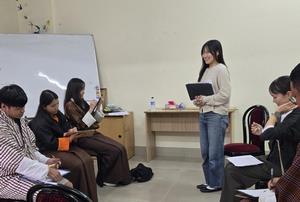
Exchange Program at Bhutan Japanese Language School
From September 15 to September 20, 2025, a study tour to Bhutan as part of the Practicum for Convivial Global Society was conducted.
Prior to the field survey, students conducted preliminary studies on Bhutan's history and current social conditions starting in early June, setting their own research topics. This year's two participating students set their research themes as “A Study on Bhutanese Youth's Outlook on Life and Career Choices” and “Industry and Identity Surrounding Bhutanese Traditional Attire: Focusing on Young People's Styling and Awareness,” respectively. Both students drafted research plans and interview questionnaires, steadily progressing with preparations for the fieldwork.
The field survey was conducted over a 7-night, 8-day itinerary: 3 nights in the capital, Thimphu; 2 nights in the remote area of Gasa; and 2 nights in Paro, which has an international airport.
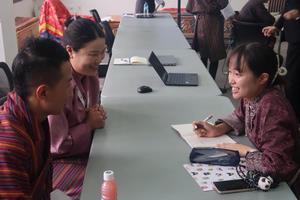
Interview with National Staff at JICA Bhutan Office
In Thimphu, we visited the Bhutan Japanese Language School and the JICA Bhutan Office, as well as the Royal Textile Museum, Kelzang Handicraft (a textile shop run by a renowned weaver), Motithang Higher Secondary School, Bhutan Overseas Jinzai Private Limited, the Language Research & Promotion Division, Department of Culture and Dzongkha Development, Ministry of Home Affairs, and Project Dragon, a model and talent agency planning to publish a fashion magazine. Interviews were conducted at each location. Although most visits were concentrated in Thimphu, in between we traveled to places like Tashichho Dzong and Bhutan's premier local markets, gaining opportunities to experience the deep devotion to Tibetan Buddhism and the daily lives of the local people.
After a roughly 7-hour drive from Thimphu, we arrived in Gasa, where we stayed with a local farming family for two nights. They treated us to Bhutanese home cooking, and we experienced rural life up close through activities like milking their cows. We also visited Gasa Hot Springs and shops in Gasa town, enjoying interactions with the local people.
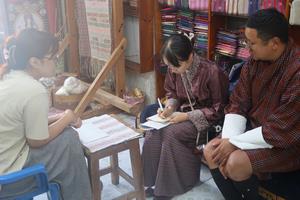
Interview at a Textile Store
In Paro, we visited Norbuling Rigter College, a private university, where we were given a campus tour and conducted interviews with students. Additionally, en route from Gasa to Paro, we observed a private elementary school's cultural performance, providing us with direct exposure to the primary education setting.
In addition to prearranged visits, we broadly gathered opinions related to our individual research topics by requesting interviews with people encountered locally and asking about relevant topics during conversations.
The intense week I spent in Bhutan taught me that the amount of information you actually encounter on the ground there is incomparable to what you learn back in Japan. Above all, the sense of closeness and emotional connection I felt toward the country was entirely different. Seeing the smiles and warmth of the Bhutanese people firsthand, and experiencing the fascinating culture and domestic circumstances, has turned me into a devoted Bhutan fan.
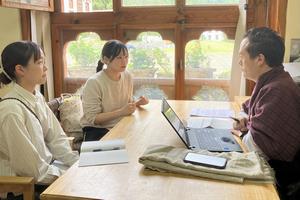
Interview at the Ministry of Internal Affairs
During the training, I asked the accompanying teachers, “What is essential for understanding different cultures?” They replied, “Making friends around the world” and “Enjoying the differences.” After completing our experience in Bhutan, we deeply resonated with these words. While we were surprised by some differences in communication styles and culture, remembering the smiles and kindness of the many people we met in Bhutan still warms our hearts. We believe it was precisely because we actually went to Bhutan that we could understand it a little and grow to like it.
This experience reaffirmed the importance of the desire to learn in cross-cultural understanding. Because we had some interest in Bhutan even before the training, we were able to travel there with a genuine desire to learn. But what if that interest isn't strong? How can we cultivate the desire to understand others?
Many people I met in Bhutan seemed to welcome foreigners who showed interest in Bhutan and actively sought to understand its culture. However, I also learned that cross-cultural understanding is always a two-way street and not always easy. In conversations with locals, I encountered situations where Bhutanese expressed dissatisfaction with their neighbors from India, describing them as “ill-mannered” or “uncooperative.”
In recent years, Japan has also seen an increase in foreign residents, and diverse people are now commonly seen on its streets. While issues concerning immigrants are increasingly discussed, are we truly making an effort to understand the “differences” that might be causing misunderstandings?
This study tour program, through comparing Bhutan and Japan, provided an opportunity to deeply reexamine our own attitudes toward cross-cultural understanding. Moving forward, I intend to carry the lessons learned from this training in my heart and continue striving to understand the various cultures and values around me.
(Sakurako Sameshima, Kyo Minakawa, senior student, Faculty of Human Life and Environmental Sciences)
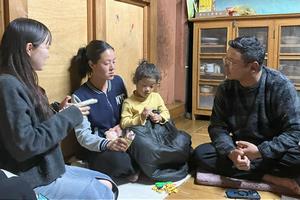 Homestay Family Interview
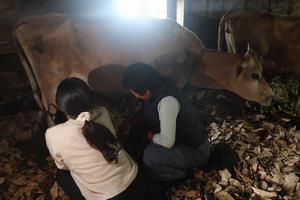 Helping with Milking



〒112-8610 東京都文京区大塚2-1-1
責任者:お茶の水女子大学グローバル協力センターHP運営委員会
E-mail:info-cwed@cc.ocha.ac.jp

Copyright © OCHANOMIZU UNIVERSITY. All rights reserved.