



- Global Collaboration Center
- Activity
- Report on 52nd SDGs Seminar “Quality Education for All”
ページの本文です。
Report on 52nd SDGs Seminar “Quality Education for All”
2026年1月14日更新
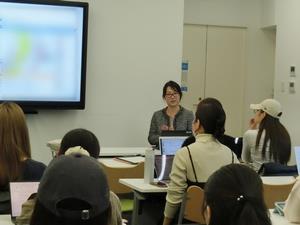
Ms. Ikeda
The SDGs seminar, "Quality Education for All," took place on Wednesday, November 6, 2025. Ms. Ami Ikeda, from the Ogata Sadako Research Institute for Peace and Development at the Japan International Cooperation Agency (JICA), was the featured speaker. Ms. Ikeda began by introducing herself and her career background. She then discussed recent global education challenges and the primary education curriculum revision project in Myanmar, in which she played an active role. This project was based on cooperation policies aimed at solving these challenges.
During the seminar, Ms. Ikeda explained that her interest in international cooperation began during her junior high school years, when she saw data on under-five mortality rates in different countries and realized that a child's birthplace affects their chances of survival. During graduate school, she gained experience in developing countries through JICA. This included serving as a short-term JOCV volunteer in Honduras and participating in a JICA internship in Bolivia.
In the field of education, the MDGs aimed to achieve universal primary education by 2015, a goal that was accomplished. However, since then, quality has become a priority. Consequently, the SDGs introduced a new goal in 2015: "Quality Education for All." Nevertheless, due to issues within schools and society, as well as the cycle of poverty, many children today are unable to attend school. Furthermore, many children worldwide, particularly in Sub-Saharan Africa, have not acquired basic literacy and numeracy skills. This situation is often referred to as a "learning crisis." I was shocked by the low accuracy rate on a math test given to middle school students and teachers in Latin America. The test covered basic arithmetic operations and fractions. Yet none of the four questions achieved a 50% accuracy rate, and the accuracy rate for fractions was as low as 12%. Even among teachers, only about 27% knew the correct answer to dividing decimals, which drew gasps of surprise from the audience.
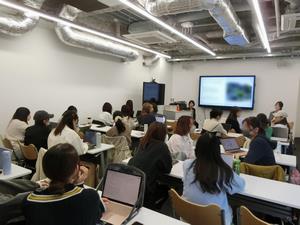
Scene of Group Work
In response to this situation, JICA has established four cooperation policies. Under Cooperation Policy 1, "Developing Textbooks and Teaching Materials to Improve Learning," we learned about the Myanmar Primary Education Curriculum Revision Project. The project aims to introduce curriculum-aligned educational activities by developing primary school curricula, textbooks, teacher manuals, and exam questions, as well as improving teacher training programs. The seven-year initiative involved numerous education experts from Japan and Myanmar. In mathematics, the familiar Japanese "tens block" calculation method was incorporated, and the developed textbooks were reportedly still in use after the program concluded. Furthermore, in response to a request from Myanmar to renovate an aging teacher training college, participants from Japan and Myanmar worked in groups to determine what information was needed and what should be considered at each stage: preparation, construction, and post-completion. Participants suggested assessing the level of deterioration, budgeting, and securing lecture rooms and lodging during construction. Ms. Ikeda shared the perspective that "the number of rooms needed, the scale, and the required facilities will change depending on how many teachers will be trained in the future." This new viewpoint, which had not been previously considered by the participants, made a strong impression.
Upon learning about this project, I realized that many individuals contribute their expertise and that its implementation requires meticulous, forward-looking deliberation. JICA's vision is "Connecting the World Through Trust," and I feel that trust is indispensable for dispatching Japanese education specialists and implementing large-scale, long-term projects. As I aspire to engage in international educational cooperation, Ms. Ikeda's insights from her field experience were invaluable. Thank you very much for the lecture.
(K.K., junior student, Department of Human and Social Sciences, Faculty of Letters and Education)



〒112-8610 東京都文京区大塚2-1-1
責任者:お茶の水女子大学グローバル協力センターHP運営委員会
E-mail:info-cwed@cc.ocha.ac.jp

Copyright © OCHANOMIZU UNIVERSITY. All rights reserved.