




- Global Collaboration Center
- Activity
- Report on 53rd SDGs Seminar “Toward Gender Equality and Women's Empowerment: Insights from the Field of International Cooperation”
ページの本文です。
Report on 53rd SDGs Seminar “Toward Gender Equality and Women's Empowerment: Insights from the Field of International Cooperation”
2026年1月14日更新
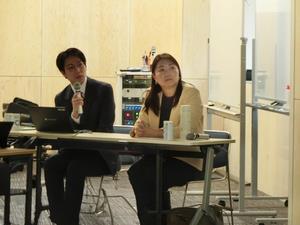
Mr. Tajima and Ms. Usami
On Thursday, November 13, 2025, the seminar "Toward Gender Equality and Women's Empowerment: Insights from the Field of International Cooperation" was held as part of the "Understanding the Frontlines of International Cooperation" series. The guest speakers were Ms. Mari Usami, an international cooperation specialist in the gender and development field at the Japan International Cooperation Agency (JICA), and Mr. Fuyuma Tajima, a staff member of the Gender Equality and Poverty Reduction Promotion Office in the Governance and Peacebuilding Department at JICA.
During the seminar, Mr. Tajima discussed his work at the office and the implementation of gender mainstreaming in projects based on the global agenda of "gender equality and women's empowerment." Ms. Usami shared insights on supporting victims of gender-based violence (GBV) and efforts to eliminate it, using initiatives in Pakistan as an example.
The Gender Equality and Poverty Reduction Promotion Office at JICA, which Mr. Tajima is affiliated with, primarily handles the following tasks:
1)Formulating and implementing projects with gender equality and women's empowerment as their main objectives.
2) Integrating gender into projects in other sectors.
3) Communicating and organizing JICA's gender-related policies and engaging with external organizations.
After reviewing the actual guidelines and indicators and learning about their work, I realized the importance of considering a gender perspective in all fields and sectors.
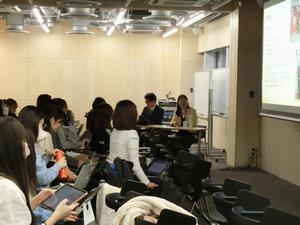
Scene from the venue
The most impressive part of Ms. Usami's presentation was her discussion of the complexity of gender issues and the need for comprehensive support for victims of gender-based violence (GBV)—support extending beyond protection and relief to include independence and social reintegration. In Pakistan, where Ms. Usami worked, GBV remains a significant social challenge. Harmful practices persist, including physical and sexual violence by husbands or partners, child marriage, forced marriage, and honor killings. In Punjab Province, JICA has been providing support in collaboration with various partner organizations. The goal is to strengthen the provincial support system for GBV victims based on a victim-centered approach that promotes their protection, economic independence, and social reintegration. Later in the lecture, Ms. Usami explained how this "victim-centered approach" is implemented and the changes it has brought about, using specific examples. This approach respects each victim's individual will and choices, prioritizing their safety and dignity above all else when providing services. However, in societies like Pakistan, where family systems and gender norms are deeply entrenched, administrative officials often believe that "reuniting the victim with their family" is the best solution. This often leads to overlooking the victim's own wishes. In this context, JICA's training for staff who interact directly with survivors aims to change support providers' awareness and actions, gradually yielding results. For example, reports indicate that crisis center staff who previously strongly pushed for reconciliation began carefully considering "what the victim wants first" through case management. There was also an increase in cases where victims were connected to psychological care and legal support. This change was achieved through knowledge training, repeated role-playing, and case studies.
Another impressive aspect of the pilot activities was the introduction of a new support model called the Transitional Home. Unlike traditional shelters, which focus solely on emergency protection, the Transitional Home provides medium- to long-term support to help victims become self-reliant. It improves the quality of support by providing victims with vocational training and counseling in a safe environment. This allows victims to prepare for reintegration into society at their own pace.
According to Ms. Usami, women who secured employment through the Transitional Home and rebuilt their lives independently exemplify the project's success. These women have also contributed to a shift in mindset among partner organizations. Even after the project concluded, the Transitional Home continues to operate in Faisalabad District. I consider it a significant accomplishment that the support model is taking root as a state government system.
Through this seminar, I was reminded that promoting gender equality and supporting victims of gender-based violence are critical issues tied directly to human dignity, not merely one aspect of international cooperation. In societies where gender-based violence is rampant, there are many challenges. However, the seminar offered hope that steady improvements through institutional development and on-the-ground practice can bring about tangible change, even in regions facing significant challenges.
(A.W., Department of Human and Social Sciences, Faculty of Letters and Education)



〒112-8610 東京都文京区大塚2-1-1
責任者:お茶の水女子大学グローバル協力センターHP運営委員会
E-mail:info-cwed@cc.ocha.ac.jp

Copyright © OCHANOMIZU UNIVERSITY. All rights reserved.