



- Global Collaboration Center
- Activity
- Report on 54th SDGs Seminar “Global Health and Japan: How the World and Japan Confronted the Threat of Pandemics”
ページの本文です。
Report on 54th SDGs Seminar “Global Health and Japan: How the World and Japan Confronted the Threat of Pandemics”
2026年1月14日更新
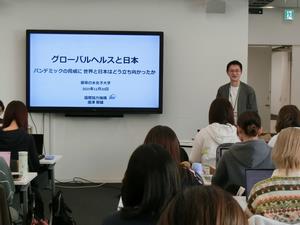
Mr.Takizawa
On November 20, 2025, a seminar titled "Global Health and Japan: How the World and Japan Confronted the Threat of Pandemics " was held. The guest speaker was Mr. Ikuo Takizawa, who has been involved in international cooperation with the Japan International Cooperation Agency (JICA) for many years.
After graduating from university, Mr. Takizawa joined JICA. His extensive experience includes long-term field assignments—four years in the Philippines and two years in Kenya—as well as visits to approximately 60 countries through his work and his own study abroad experience. During the seminar, he drew on his experience to lead a discussion on global healthcare trends, JICA's response to the pandemic crisis, and the importance of international cooperation.
At the beginning of the seminar, Mr. Takizawa discussed non-communicable diseases (NCDs), which have become a serious global health concern. As discussed at the 2025 UN High-Level Meeting, NCDs are now the leading cause of death in developing countries, surpassing infectious diseases and maternal and child health issues. Contributing factors include a shift from historical undernutrition to overnutrition due to dietary changes and consumption habits involving tobacco, alcohol, and sugar-sweetened beverages. While there are international political efforts to impose market regulations, the difficulty of international policymaking was highlighted. This was exemplified by the failure to reach unanimous agreement on the political declaration at the UN High-Level Meeting due to opposition from countries such as the United States and Argentina. This situation demonstrates that "political and market forces can sometimes become barriers to health promotion."
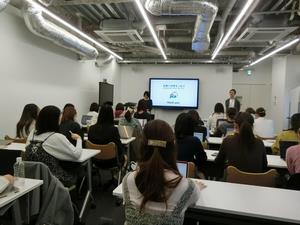
Question-and-Answer Session
Drawing from his experience with Japan's resources, Mr. Takizawa emphasized the strengths of the country's healthcare sector. First, Japan has one of the lowest infant mortality rates globally, and its expertise in maternal and child health could benefit the world. He also praised Japan's low mortality rates from non-communicable diseases (NCDs) and its low rates of overweight populations. Additionally, despite having a high proportion of people aged 65 and over (29.3%), Japan kept the increase in mortality rates during the pandemic to a minimum.
However, the reality is that "Japan is not a health utopia." It has the lowest self-reported health levels among OECD member countries. This suggests that the country is facing challenges regarding mental and social health, including high suicide rates, which cannot be fully explained by its large elderly population.
During the second half of the seminar, we learned how JICA responded to the novel coronavirus disease. Although JICA's technical cooperation relies on dispatching personnel, I was surprised to learn that, due to the PHEIC (Public Health Emergency of International Concern) declaration and travel restrictions, JICA carried out the largest temporary repatriation of personnel in its history. The fact that the number of personnel stationed overseas dropped from 6,200 in March to just 500 by the end of June underscores the severity of the crisis.
Mr. Takizawa acknowledged public sentiment questioning whether domestic support should take priority under these circumstances and addressed the need to continue international cooperation. He explained that international cooperation is not merely a matter of give and take but rather mutual assistance built on trust, citing experiences such as the Great East Japan Earthquake as examples. This provided an opportunity to reconsider the nature of cooperation when other countries face crises as well, such as during the ongoing pandemic.
Through this seminar, I gained a deep understanding of the dual nature of international cooperation, including the political and economic challenges faced on the ground and Japan's globally recognized strengths in healthcare, as well as its domestic mental and social challenges. Regarding the significance of international cooperation during a global crisis, such as a pandemic, I strongly felt the importance of moving beyond the traditional image of cooperation as assistance from a position of relative privilege and embracing the perspective of mutual aid based on trust instead. The seminar closed with the message that "our ability to create the future together is being tested." I, too, wish to apply this global perspective combined with deep insight into my own country's situation to my future learning and actions.
(K.S., sophomore student, Faculty of Human Life and Environmental Sciences)



〒112-8610 東京都文京区大塚2-1-1
責任者:お茶の水女子大学グローバル協力センターHP運営委員会
E-mail:info-cwed@cc.ocha.ac.jp

Copyright © OCHANOMIZU UNIVERSITY. All rights reserved.