




- Global Collaboration Center
- Activity
- Report on 56th SDGs Seminar "SDGs and Human Security: Has the Era of International Public Goods Come to an End?"
ページの本文です。
Report on 56th SDGs Seminar "SDGs and Human Security: Has the Era of International Public Goods Come to an End?"
2026年6月17日更新
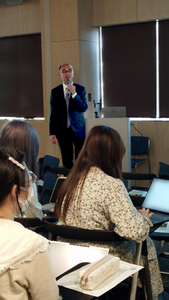
Mr. Mine
On Thursday, May 14, 2026, the 56th SDGs Seminar, titled “SDGs and Human Security: Has the Era of International Public Goods Come to an End?,” was held, featuring Yoichi Mine, Director of the Sadako Ogata Institute for Peace and Development at the Japan International Cooperation Agency (JICA).
The theme of the lecture was “Reflecting on Dignity in the Era of the SDGs.” During the lecture, we explored the concept of “dignity” using the principle of “human security” as a guide.
Mr. Mine explained what the SDGs are, why they are attracting global attention, and how they came to be. What left a particularly strong impression on me during the lecture was the phrase “Leaving No One Behind,” which is the central principle of the SDGs. Mr. Mine asked, “How would you feel if you were the one being left behind?”
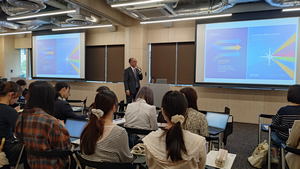
Scene from the venue
Until now, I had considered issues such as hunger, poverty, and educational disparities from the perspective that there are people in need of assistance. However, I had never imagined being in the position of being left behind. When I pictured that situation, I felt intense anxiety and fear. I wondered what would happen if I were left behind as the world progressed and received no help from anyone.
I also realized that I had lived my life as part of the “group less likely to be left behind”—that is, as a member of the privileged majority. I realized that the lifestyle and environment I had taken for granted are supported by numerous conditions and social systems and are by no means guaranteed. I truly understood that the SDGs are not just issues concerning distant countries or specific individuals, but issues that affect each one of us.
Regarding “dignity,” Mr. Mine introduced not only the dictionary definition but also its meaning in the 19th century and definitions from several of his own books. The Kōjien definition is “toutoku ogosoka de, okashigatai koto” (something noble, solemn, and beyond reproach). Although transliterating the kanji into hiragana may seem like a mere technicality, I felt that deliberately avoiding kanji gave the term flexibility and prevented its meaning from becoming too restricted. This led me to further reflect on the depth of the word “dignity.”
I was also surprised to learn that “dignity” was originally a term used to denote high status or rank, such as that of the royal family. However, after the two world wars, “dignity” came to be understood not as something reserved for a select few, but as something every individual should possess. This shift was driven by the tragic experiences and countless sacrifices caused by war. Until now, I had never given much thought to safeguarding dignity, but I came to feel that it is a value we must protect, just like peace.
Through this lecture, I learned that the SDGs and human security are not issues for distant countries or specific individuals but matters that concern us all. I also learned that dignity is not a given, but rather a value built up through many sacrifices throughout history. From now on, I want to cultivate empathy for people in different circumstances and continue reflecting on how to create a “society where no one is left behind.”
(Igarashi, Faculty of Letters and Education)
【related links】
JICA Ogata Sadako Research Institute for Peace and Development



〒112-8610 東京都文京区大塚2-1-1
責任者:お茶の水女子大学グローバル協力センターHP運営委員会
E-mail:info-cwed@cc.ocha.ac.jp

Copyright © OCHANOMIZU UNIVERSITY. All rights reserved.