



- Institute for SDGs Promotion
- FY2025 The 3rd SDGs Research Grant Findings Report Meeting
ページの本文です。
FY2025 The 3rd SDGs Research Grant Findings Report Meeting
2025年6月27日更新
This event has concluded.
*This announcement is intended for university affiliates only.
2025 The 3rd SDGs Research Grant Findings Report Meeting
The Institute for SDGs Promotion provides grants to support individual research, joint research with scholars inside and outside the university, and collaborative research with companies and other institutions. The purpose of the program is to identify research that will drive SDGs initiatives at the university and to revitalize research and educational activities that contribute to the Sustainable Development Goals (SDGs).
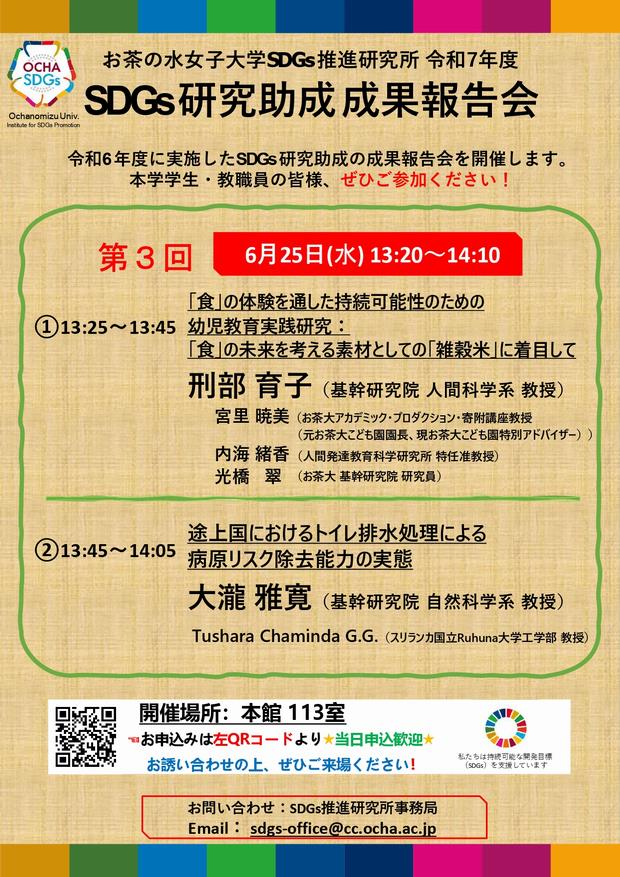
We are pleased to announce that the findings from the FY2024 SDGs Research Grants will be reported in a series of three sessions. We warmly welcome participation from students, faculty, and staff. Please feel free to share this information with colleagues on campus.
The third session will feature presentations by Professor Ikuko Gyobu (Faculty of Human Life and Environmental Sciences) and Professor Masahiro Otaki (Faculty of Transdisciplinary Engineering for Sustainability). Each presenter will have approximately 20 minutes (allocated as 15 minutes for the report and 5 minutes for Q&A).
<FY2025 The 3rd SDGs Research Grant Findings Report Meeting>
Date & Time: Wednesday, June 25, 1:20-2:10 P.M.
Venue: Main Building, Room 113 (In-person)
Presentations
Report 1: “Practical Research on Early Childhood Education for Sustainability Through ‘Food’ Experiences: Focusing on ‘Millet Rice’ as a Material for Considering the Future of ‘Food’”
(Prof. Ikuko Gyobu; Department of Human Life Studies, Faculty of Human Life and Environmental Sciences)
Report 2: “Actual Conditions of Pathogen Risk Removal Capabilities by Toilet Wastewater Treatment in Developing Countries”
(Prof. Masahiro Otaki; Department of Human-Environmental Engineering, Faculty of Transdisciplinary Engineering for Sustainability)
Registration
Please register via this Forms link below:
https://forms.office.com/r/suYB6cBaLQ

* We appreciate your registration to help us prepare for the event.
* Walk-ins are also welcome. Please feel free to invite colleagues and attend.
Presentation Abstracts
Report 1
Title: Practical Research on Early Childhood Education for Sustainability Through “Food” Experiences: Focusing on “Millet Rice” as a Material for Considering the Future of “Food”
Researchers:
・ Ikuko Gyobu (Professor, Human Sciences Division, Faculty of Core Research)
・ Akemi Miyazato (Professor, Ocha-dai Academic Production / Endowed Chair; Former Director, Ochanomizu University Center for Early Childhood Education and Care [Kodomo-en]; Current Special Advisor, Kodomo-en)
・ Shoka Utsumi (Project Associate Professor, Institute of Human Development and Education)
・ Midori Mitsuhashi (Researcher, Faculty of Core Research, Ochanomizu University)
Abstract: Millets, due to their high nutritional value, functional benefits, and strong environmental adaptability, are expected to play an important role in global food security and hunger reduction as sustainable crops. They have attracted international attention, with the United Nations designating 2023 as the International Year of Millets.
This study examined the potential of millet rice as an educational material for early childhood programs aimed at fostering a sustainable society, drawing on food-education practices at the Ochanomizu University Center for Early Childhood Education and Care (Kodomo-en). Through these activities, children, childcare professionals, and parents developed an interest in millet rice.
The findings suggest that millets contribute to SDG 2 (Zero Hunger), SDG 3 (Good Health and Well-being), and SDG 13 (Climate Action). Additionally, experiencing millets—which have long supported the diversity of Japanese food culture and natural environments—helped participants recognize biodiversity, linking the practice to SDG 15 (Life on Land).
This initiative also aligns with SDG 4 (Quality Education), specifically Target 4.7, which emphasizes ensuring that all learners acquire the knowledge and skills needed to promote sustainable development. The results of this practice-based research have been compiled in the publication “Millet Rice: Bunkyo City Ochanomizu University Kodomo-Ureshii-Oishii (Happy Children, Delicious Food) Project.”
Report 2
Title: Actual Conditions of Pathogen Risk Removal Capabilities by Toilet Wastewater Treatment in Developing Countries
Researchers:
・ Masahiro Otaki (Professor, Natural Science Division, Faculty of Core Research)
・ Tushara Chaminda G.G. (Professor, Faculty of Engineering, University of Ruhuna, Sri Lanka)
Abstract: In many developing regions, the spread of flush toilets has advanced alongside the improvement of water supply systems. However, sewerage development has not kept pace, and wastewater is often managed through individual on-site treatment systems. Because flush toilet wastewater is frequently treated using non-flush “pit latrine” systems, wastewater may infiltrate surrounding soil without sufficient treatment time, posing challenges to achieving SDG 6 (Clean Water and Sanitation).
This study investigated fecal microbial indicators in soil surrounding individual toilet wastewater treatment sites in Sri Lanka, aiming to understand the spread of pathogen risks and to propose appropriate treatment systems.
Research conducted at four sites in the Galle region of southern Sri Lanka confirmed, through microbial indicator analysis, that the introduction of septic tanks compatible with flush toilets is essential for achieving SDG 6 in areas without sewerage systems.
However, data concerning viruses remain insufficient, and improving soil-based viral indicator detection is necessary for future studies. Although this research examined the involvement of soil moisture content and bound water, their influence was found to be minimal.