



- Institute for SDGs Promotion
- FY2025 The 2nd SDGs Research Grant Findings Report Meeting
ページの本文です。
FY2025 The 2nd SDGs Research Grant Findings Report Meeting
2025年5月21日更新
This event has concluded.
*This announcement is intended for university affiliates only.
FY2025 The 2nd SDGs Research Grant Findings Report Meeting
The Institute for SDGs Promotion provides grants to support individual research, joint research with scholars inside and outside the university, and collaborative research with companies and other institutions. The purpose of the program is to identify research that will drive SDGs initiatives at the university and to revitalize research and educational activities that contribute to the Sustainable Development Goals (SDGs).
We are pleased to announce that the findings from the FY2024 SDGs Research Grants will be reported in a series of three sessions. We warmly welcome participation from students, faculty, and staff. Please feel free to share this information with colleagues on campus.
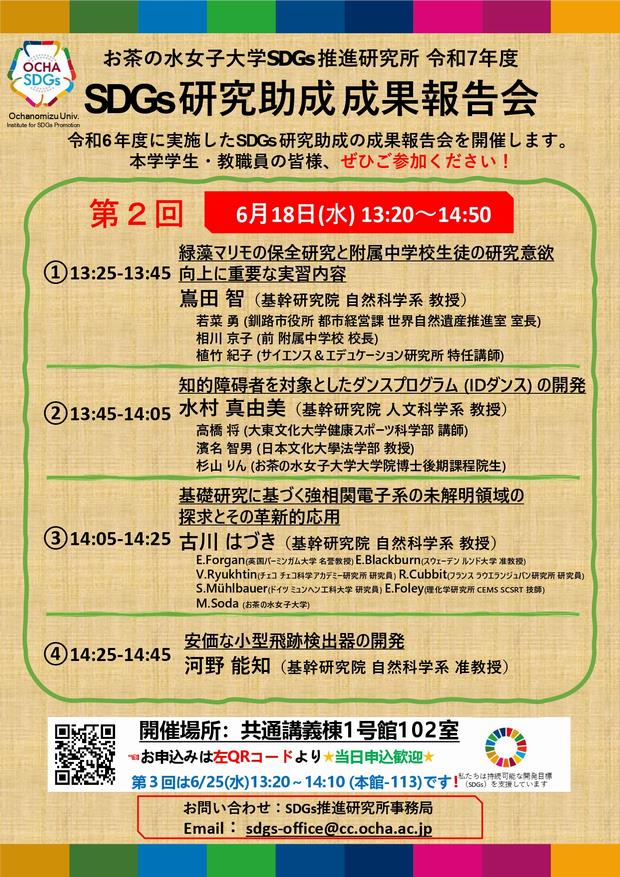
The second session will feature presentations by Professor Satoshi Shimada (Faculty of Science), Professor Mayumi Mizumura (Faculty of Letters and Education), Professor Hazuki Furukawa (Faculty of Science), and Associate Professor Yoshinori Kohno (Faculty of Science). Each presenter will have approximately 20 minutes (allocated as 15 minutes for the report and 5 minutes for Q&A).
<FY2025 The 2nd SDGs Research Grant Findings Report Meeting>
Date & Time: Wednesday, June 18, 1:20-2:50 P.M.
Venue: Inter-Faculty Building 1, Room 102 (In-person)
Presentations
Report 1: “Conservation Research of Marimo and Practical Training Content Important for Improving Research Motivation of Attached Junior High School Students”
(Prof. Satoshi Shimada ; Department of Biology, Faculty of Science)
Report 2: “Development of a Dance Program (ID Dance) for Persons with Intellectual Disabilities”
(Prof. Mayumi Mizumura; Department of Performing Arts, Faculty of Letters and Education)
Report 3: “Exploration of Unexplained Regions of Strongly Correlated Electron Systems Based on Basic Research and Their Innovative Applications”
(Prof. Hazuki Furukawa ; Department of Physics, Faculty of Science)
Report 4: “Development of an Inexpensive Compact Tracking Detector”
(Assoc. Prof. Yoshinori Kohno ; Department of Physics, Faculty of Science)
Registration
Please register via this Forms link below:
https://forms.office.com/r/suYB6cBaLQ

* We appreciate your registration to help us prepare for the event.
* Walk-ins are also welcome. Please feel free to invite colleagues and attend.
Presentation Abstracts
Report 1
Title: Conservation Research of Marimo and Practical Training Content Important for Improving Research Motivation of Attached Junior High School Students
Researchers:
・ Satoshi Shimada (Professor, Natural Science Division, Faculty of Core Research)
・ Isamu Wakana (Director, World Natural Heritage Promotion Office, Urban Management Division, Kushiro City Hall)
・ Kyoko Aikawa (Former Principal, Junior High School of Ochanomizu University)
・ Noriko Uetake (Project Lecturer, Science & Education Center)
Abstract: Marimo are designated as Endangered Class I by the Ministry of the Environment's Red List and as a Special Natural Monument by the Agency for Cultural Affairs. On the other hand, Marimo is an alga familiar to many as a souvenir. In this study, we considered that using Marimo—which is endangered yet well-known—could contribute to achieving SDG 15 (Life on Land) and SDG 4 (Quality Education).
In our conservation research, we analyzed the photosynthetic characteristics of Marimo at different water depths and layers, corresponding to their growth stages from small to large sizes, to investigate their adaptation to light environments. Additionally, in practical training using Marimo for students at the Junior High School of Ochanomizu University, we conducted pre- and post-training questionnaires and semi-structured interviews to survey whether the students' motivation for scientific research and their sense of ownership regarding the SDGs had improved. At this report meeting, we will report on the analysis results regarding the photosynthetic activity of Marimo and on effective practical training content for junior high school students.
Report 2
Title: Development of a Dance Program (ID Dance) for Persons with Intellectual Disabilities
Researchers:
・ Mayumi Mizumura (Professor, Human Sciences Division, Faculty of Core Research)
・ Tasuku Takahashi (Lecturer, Department of Sport and Health Science, Daito Bunka University)
・ Tomoo Hamana (Professor, Faculty of Law, Nihon Bunka University)
・ Rin Sugiyama (Ph.D. Student, Ochanomizu University)
Abstract: This study aimed to develop a dance program that is feasible for persons with intellectual disabilities (ID) and effective as exercise, directly realizing the SDG "Good Health and Well-being," and addressing perspectives such as "Quality Education" through exercise and "Reduced Inequalities."
Since there are few preceding studies on the motor functions of persons with ID and many unknowns regarding challenges related to exercise implementation, we surveyed the motor functions of persons with ID, including those with Down syndrome, to extract elements that particularly require improvement. In this study, we envisioned a dance program ("ID Dance") that can be introduced as a warm-up for Judo for persons with ID ("ID Judo") and attempted to develop the program and utilize it in the field. Increasing physical activity leads to a reduction in transportation using fossil fuels; therefore, in recent years, it has been stated in the health and welfare sector, led by the WHO, that this also constitutes "Climate Action."
Report 3
Title: Exploration of Unexplained Regions of Strongly Correlated Electron Systems Based on Basic Research and Their Innovative Applications
Researchers:
・ Hazuki Furukawa (Professor, Natural Science Division, Faculty of Core Research)
・ Edward Forgan (Emeritus Professor, University of Birmingham, UK)
・ Elizabeth Blackburn (Associate Professor, Lund University, Sweden)
・ Vasyl Ryukhtin (Researcher, Czech Academy of Sciences, Czech Republic)
・ Robert Cubitt (Researcher, Institut Laue-Langevin, France)
・ Sebastian Mühlbauer (Researcher, Technical University of Munich, Germany)
・ Edward Foley (Technician, RIKEN CEMS SCSRT)
・ Minoru Soda (Ochanomizu University)
Abstract: Research on strongly correlated electron systems is important as a fundamental technology for energy conversion materials and electronic devices. For example, superconducting technology is expected to contribute to the realization of clean energy and quantum computers, while research on skyrmions is expected to contribute to the development of energy-saving magnetic devices.
In FY2024, using the superconductor LaNiC₂, which has broken spatial inversion symmetry, we challenged ourselves to demonstrate a new "helical flux phase" that had been theoretically predicted. We succeeded in demonstrating its existence for the first time in the world through experiments using the world's highest-performance small-angle neutron scattering instrument, D33, at the Institut Laue-Langevin (ILL) in France.
This helical flux phase appears due to the interaction between local electric fields and magnetic fields caused by the asymmetric crystal structure. In the experiment, it was also confirmed that structural distortion increases as the magnetic field strengthens. Moving forward, we plan to further elucidate the characteristics of this phase and deepen our understanding of superconductivity.
Report 4
Title: Development of an Inexpensive Compact Tracking Detector
Researchers: Takanori Kohno (Associate Professor, Natural Science Division, Faculty of Core Research)
Abstract: Particle detectors used in elementary particle physics experiments have been applied to medical and various scientific measurements as X-ray imaging sensors and high-sensitivity photosensors. Among particle detectors, semiconductor detectors exist for the purpose of visualizing the tracks of charged particles (tracking detectors), and development is currently ongoing in areas such as sensor miniaturization, high-speed data acquisition, and enhanced radiation resistance. However, because they are custom-made by semiconductor manufacturers and are expensive, their use is currently limited to areas requiring high performance.
This study aims not to develop a high-performance detector, but to produce an inexpensive tracking detector with a positional resolution of approximately 1 mm² to widely realize its use in laboratories. We will introduce the implementation of a multi-channel readout board using inexpensive components, the overall design of the detector, and the current status of development.